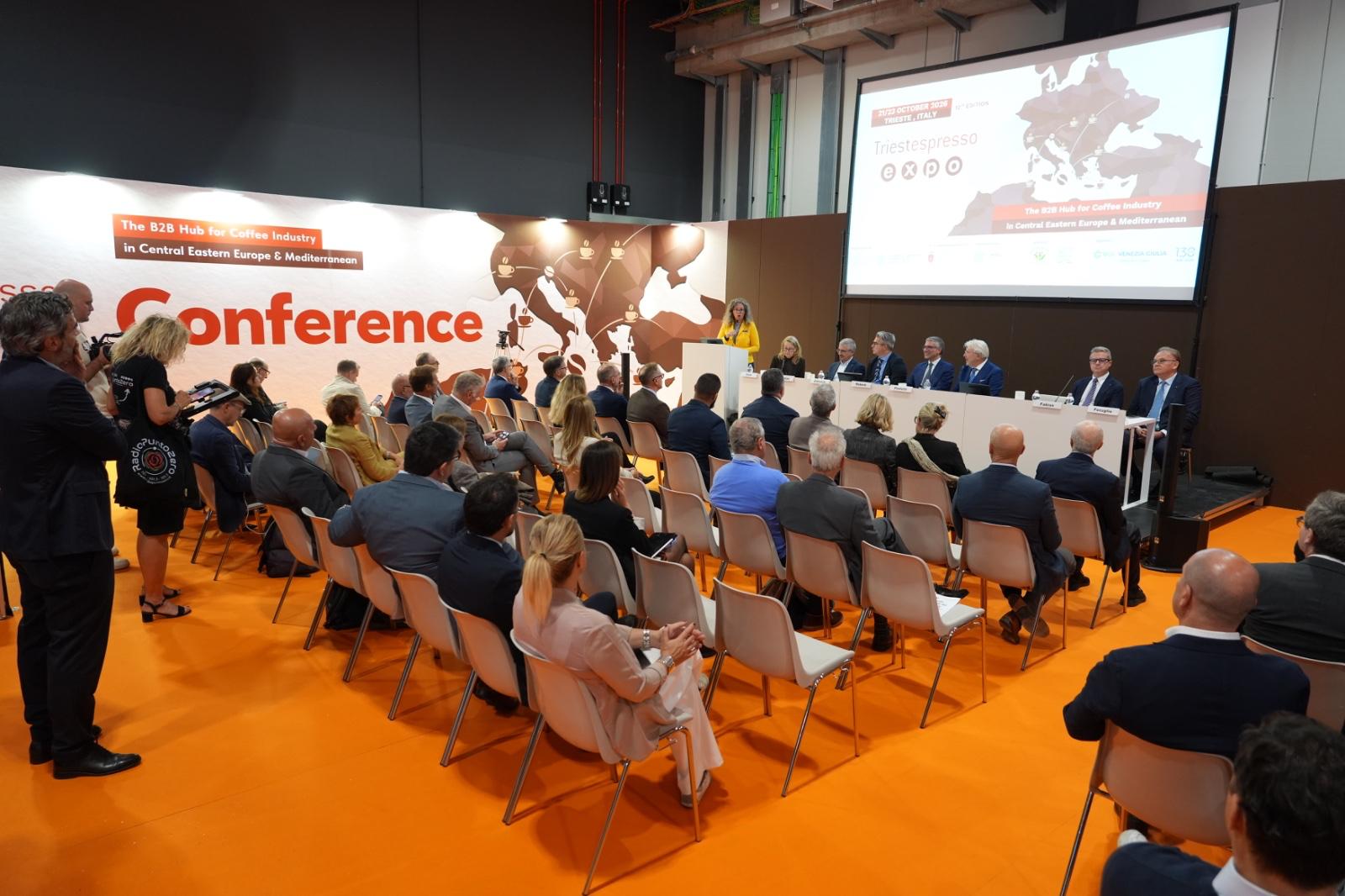
THE FIRST DAY OF TRIESTESPRESSOEXPO FEATURES INSIGHTS INTO THE COFFEE SUPPLY CHAIN
The first day of TriestEspressoExpo, which opened today at the Generali Convention Center in Trieste, featured a series of discussions exploring various aspects of the coffee supply chain.
Among the events was the conference “Italy–El Salvador: Quality and Sustainability in Every Cup”.
“This afternoon, we presented the first initiative that Unioncamere is implementing in collaboration with the Italian Agency for Development Cooperation. The project brings us together with BMTI—the company within our Chamber of Commerce system dedicated to market development and transparency, starting with agri-food markets—and with El Salvador’s institutions, beginning with the Ministry of Agriculture and Livestock, supported by the Salvadoran Coffee Institute and El Salvador’s National Centre for Agricultural and Forestry Technology,” said Antonio Paoletti, Deputy Vice President of Unioncamere.
Barbara Gamboni, from Office VI of the Italian Agency for Development Cooperation, explained that the project presented today “is extremely interesting because, in a way, it encapsulates Italy’s coffee strategy, which aims to bring all supply chain stakeholders, both public and private, together in synergistic projects where everyone plays their part in ensuring a sustainable path for the coffee market and industry.”
“Mauricio Sansivirini, President of the Salvadoran Coffee Institute, is giving a major boost to coffee cultivation,” said the Institute’s Administrative Director, Lilian Haydee Martínez Cornejo, in her speech. She also highlighted the “great work being carried out by the government, together with the President and the Deputy Minister of Agriculture and Livestock. We place great importance on strategic partnerships such as this one with Italy, focusing on Salvadoran coffee and cocoa.”
The project’s primary objective is to share expertise and support Salvadoran institutions in implementing practical tools, already tested in Italy, for market monitoring and development. These tools will be adapted to the local context and applied to two key supply chains for El Salvador: coffee and cocoa.
“The second key objective is to promote the excellence of Salvadoran products on international markets, starting with our own,” Paoletti added. “Through training on European Union trade regulations and the organisation of direct meetings between local producers and Italian buyers, we aim to establish stable, long-term trade agreements. TriestEspresso Expo thus represents the first major concrete opportunity to turn this collaboration into market opportunities and lasting business relationships.”
Another event on the first day was the conference “EUDR: European Coffee Faces the Traceability Challenge”. The key issue addressed in Trieste was whether companies are ready and equipped with dedicated management software. While most companies are reasonably familiar with the regulation, not all are ready to implement it, with the largest companies being the main exception.
Lawyer Matteo Levantino, an expert in EUDR regulations, explained that “among the key aspects to highlight are the importer’s full responsibility for ensuring that products placed on the EU market are deforestation-free; the strict requirements for geolocating the individual plot of land where the imported product was grown and for complying with local legislation concerning land-use rights, labour law, human rights and the rights of local Indigenous peoples; the need to establish a corporate EUDR risk management structure, with software, procedures, dedicated personnel and clearly defined responsibilities at management level, to address suspected cases of non-compliance; severe penalties, including the seizure and destruction of non-compliant products and financial penalties exceeding 4% of annual turnover; and, last but not least, damage to a company’s reputation among its customers.”
The event entitled “Coffee & Education: Brewing Knowledge, Growing the Future”, introduced by Anna Illy on behalf of the Ernesto Illy Foundation, also attracted considerable interest.
During TriestEspresso Expo, the Venezia Giulia Chamber of Commerce is also present with its Double Transition Helpdesk, which supports companies in their digital innovation and sustainability journeys.
The Helpdesk contributes to the organisation of technical seminars on topics of particular interest to the coffee supply chain, including the PPWR packaging regulation, the EUDR deforestation regulation and combating greenwashing.
Alongside training, the Helpdesk offers free individual 30-minute consultations, providing an initial opportunity to discuss specific needs with experts and identify possible areas for further investigation. Consultations cover regulations and sustainability, the circular economy, technological innovation and digital transition.
Bookings will open progressively, with priority given first to local businesses and subsequently to the trade fair’s exhibitors. Through this initiative, the Chamber of Commerce aims to provide tangible support to businesses by connecting specialist knowledge, regulatory requirements and development opportunities.
The day concluded with the Capo in B Championship, in which seven Trieste baristas competed to make the best cappuccino served in a glass. The winner of the 2026 edition was Pamela Skalamera of Home Sapori di Casa, who also won the title in 2025.
For the full programme, visit: https://triestespresso.it/eventi
Andrea Bulgarelli
Media & Communication Manager
TriestEspresso Expo
www.triestespresso.it
press@triestespresso.it
Phone: +39 040 6701264
Mobile: +39 335 7824405
Micol Brusaferro
Press Office
Mobile: +39 320 9718524